A superb Venus inferior conjunction by Guy Ottewell
Venus will reach inferior conjunction – when it will pass between Earth and the sun – on March 23, 2025, moving from the evening to the morning sky. This inferior conjunction will find Venus 8.4 degrees from the sun. So for a few days before conjunction, you might be able to spot Venus shortly before sunset and before sunrise. Be sure to look ONLY when the sun is below the horizon. Chart via EarthSky.org.
UK astronomer Guy Ottewell published this blog Superb inferior Venus at his website on March 15, 2025. Reprinted with permission. Edits by EarthSky.
Venus has an important appointment at 1 UTC on March 23, 2025, when it will pass between us and the sun. Venus does this roughly every 19.5 months. However, this one offers you a chance to spot Venus in both the evening and morning sky on the same day.
Astronomers call this an event inferior conjunction, as opposed to superior conjunction which is when Venus is beyond the sun. So the words mean nearer and farther.
At 1 UTC on March 23, 2025, Venus passes between Earth and the sun moving to the morning sky. Astronomers call this inferior conjunction. For a few days before then, observers might be able to see Venus in both the morning and evening twilight. This chart shows the visible part of the disk of Venus at 5-day intervals as it races toward – and after – its inferior conjunction. Venus is exaggerated 500 times in size. Image via Guy Ottewell. Used with permission.
Yet, this event is far from inferior in a qualitative sense. This will be one of the most superb inferior conjunctions of Venus. That’s because Venus will pass about as far north of the sun as possible. And that means for a few days before then, Venus is visible in both the morning and evening twilight.
This March 23, 2025, inferior conjunction is exceptionally favorable for observers in the Northern Hemisphere. That’s because Venus will pass 8.4 degrees from the sun, making it possible to spot it in both the morning and evening twilight for several days before March 23. And then, on March 23, Venus will set with the sun and slip away from the evening sky.
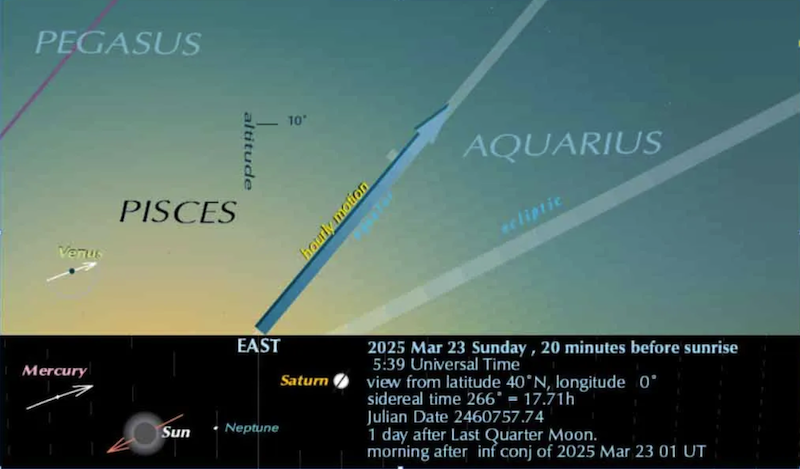
Here’s the dusk scene 5 minutes after sunset on March 22, 2025, right before Venus will reach inferior conjunction. The blue arrow on the left shows how much the sky appears to rotate in one hour. Even though Venus is about 8 degrees north of the sun, due to the angle of the ecliptic in the Northern Hemisphere, it’s only about 2 degrees higher than the sun in the sky. So both Venus and Mercury might be difficult – if not impossible – to see in the bright twilight. Image via Guy Ottewell. Used with permission.Here’s the scene 20 minutes before sunrise on March 23, 2025. That’s right before Venus will reach inferior conjunction. The blue arrow in the middle shows how much the sky appears to rotate in one hour. About 40 minutes later, Venus will be higher but the sun will be above the horizon. Image via Guy Ottewell. Used with permission.
Finder chart
On March 22 and 23, Venus appears in the morning sky close to the eastern horizon about 15 minutes before sunrise, and in the evening sky on March 22, Venus will lie very close to the western horizon about 10 minutes – or less – after sunset. It will be difficult to spot in the bright twilight on these occasions. Chart via EarthSky.
Our charts are mostly set for the northern half of Earth. To see a precise view – and time – from your location, try Stellarium Online.
Bottom line: Venus passes between Earth and the sun on March 23, 2025. Since it passes about 8.4 degrees from the sun, you might be able to see Venus in both the morning and evening twilight for a few days before then.



Aucun commentaire:
Enregistrer un commentaire