

Why causes the aurora?
Auroras appear near both the north and south poles as the aurora borealis and the aurora australis. You may have noticed more aurora alerts lately as the sun has become more active. In fact, the bright blasts of activity on the sun are directly linked to these wispy, elusive lights we see in the night sky.
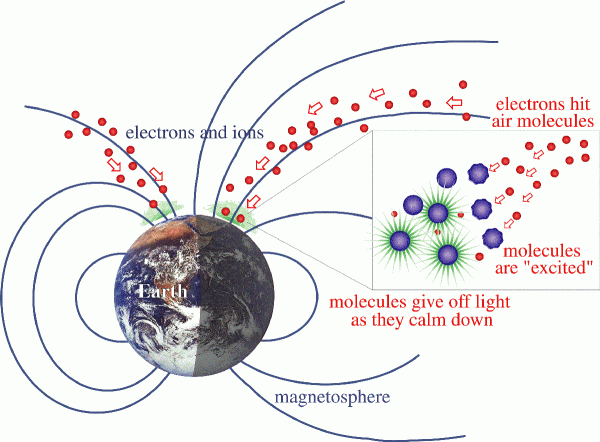
Storms on the sun that cause events such as coronal mass ejections and solar wind from coronal holes send charged particles hurtling across space. Because our sun is 93 million miles away (150 million km), the eruption we witness on the sun can take several days to reach our atmosphere. But if Earth is in the path of the particle stream, our planet’s magnetic field and atmosphere react from the impact.
When the charged particles from the sun strike atoms and molecules in Earth’s atmosphere, they excite those atoms, causing them to light up.
When charged particles interact with Earth’s atmosphere
What does it mean for an atom to be excited? Atoms consist of a central nucleus and a surrounding cloud of electrons encircling the nucleus in an orbit. When charged particles from the sun strike atoms in Earth’s atmosphere, electrons move to higher-energy orbits, further away from the nucleus. Then when an electron moves back to a lower-energy orbit, it releases a particle of light or photon.
What happens in an aurora is similar to what happens in the neon lights we see on many business signs. Electricity excites the atoms in the neon gas within the glass tubes of a neon sign. That’s why these signs give off their brilliant colors. The aurora works on the same principle, but at a far vaster scale.
The shapes of the northern and southern lights
The aurora often appears as curtains of lights, but they can also be arcs or spirals, following lines of force in Earth’s magnetic field. Most are green in color, but sometimes you’ll see a hint of pink. Strong displays might also have red, violet and white colors. The lights typically appear in the far north – the nations bordering the Arctic Ocean – Canada, Scandinavian countries, Iceland, Russia and the state of Alaska. But strong displays can extend down into more southerly latitudes. And of course, the lights have a counterpart at Earth’s south polar regions, though there is less land at high southerly latitudes for people to witness the displays.
The colors in the aurora were once a source of mystery throughout human history. But science says that different gases in Earth’s atmosphere give off different colors when they are excited. Oxygen gives off the green color of the aurora, for example. Nitrogen causes blue or red colors.
So today the mystery of the aurora is not so mysterious as it used to be. Yet people still travel thousands of miles to see the brilliant natural light shows in Earth’s atmosphere. And even though we know the scientific reason for the aurora, the dazzling natural light show can still fire our imaginations to visualize fire bridges, gods or dancing ghosts.
Ancient explanations and mythology behind the aurora
People have seen these dancing lights for millennia and have had their own explanations for them. Those who live at or visit high latitudes are sometimes lucky enough to experience these colored lights shimmering across the night sky. Some Inuit believed that they were seeing the spirits of their ancestors dancing in the flickering aurora. In Norse mythology, the aurora was a fire bridge to the sky that the gods built. You can read more about the mythology of the aurora here.

Mike Taylor’s photos of the aurora
EarthSky friend Mike Taylor shared these incredible aurora images with us.
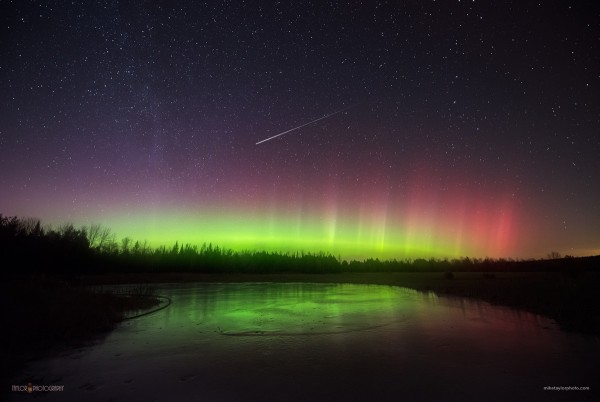
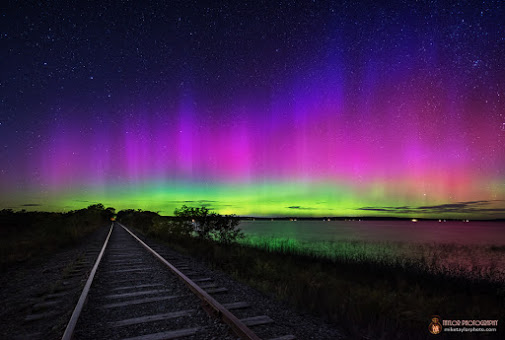
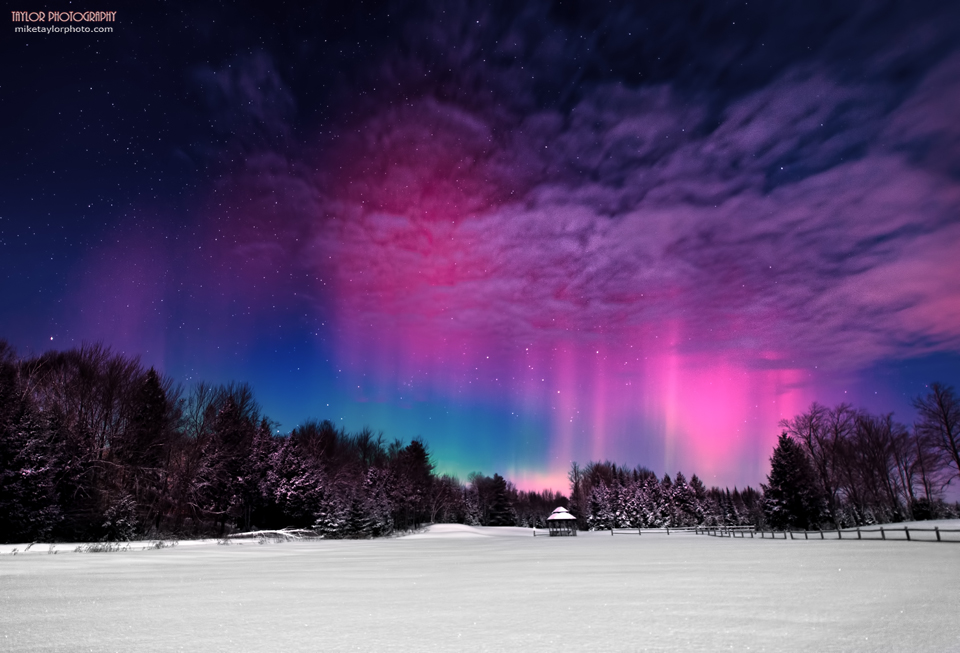
Bottom line: When charged particles from the sun strike atoms in Earth’s atmosphere, they cause electrons in the atoms to move to a higher-energy state. When the electrons drop back to a lower energy state, they release a photon: light. This process creates the beautiful aurora, or northern and southern lights.
The post What causes aurora in northern and southern skies first appeared on EarthSky.
from EarthSky https://ift.tt/SBAgjZ0
Aucun commentaire:
Enregistrer un commentaire