
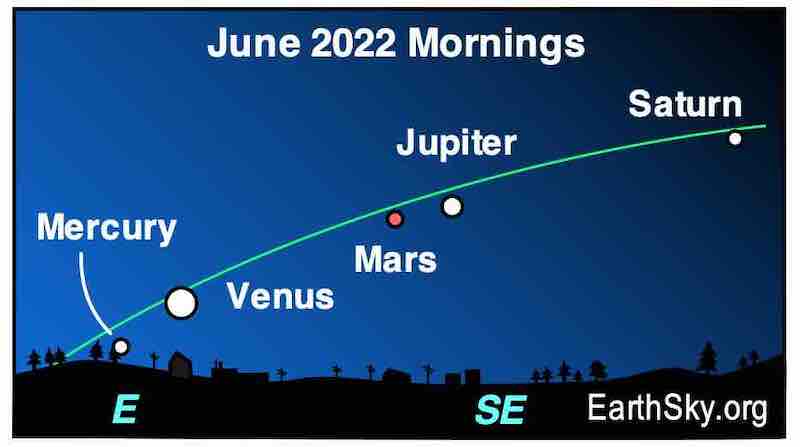
If you’ve never seen all the bright planets at once, June is your perfect chance. The five brightest planets – Mercury, Venus, Mars, Jupiter and Saturn – are lined up before dawn. They stretch across the sky from the east-northeastern horizon to above the southern horizon. And if you have patience and binoculars, you can hunt down the two challenging planets – Uranus and Neptune – that are hiding among the classical planets.
Planetary lineup before dawn
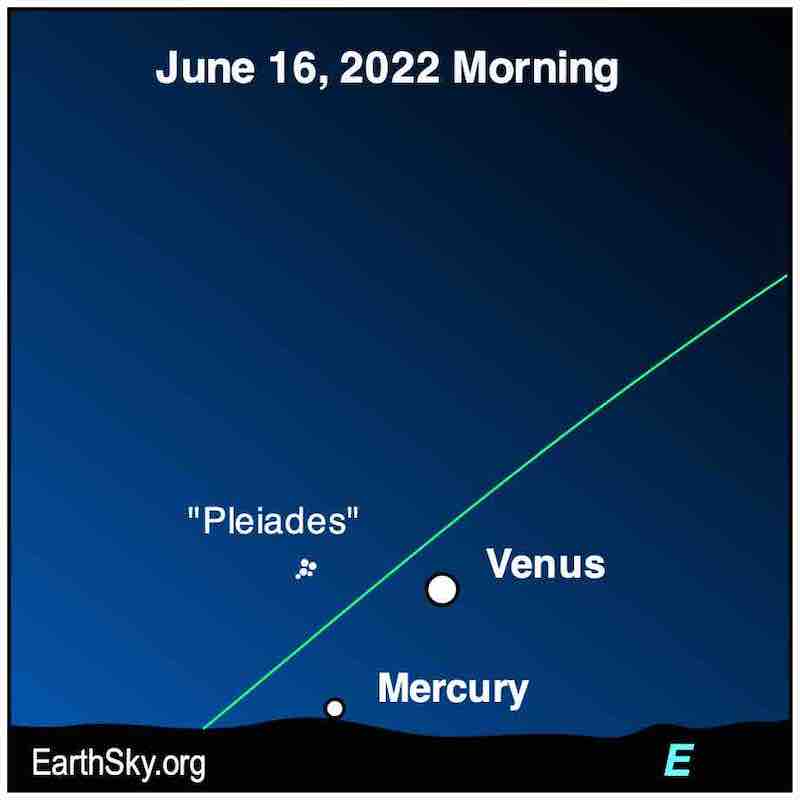
Start looking in mid-June when Mercury makes an appearance above the eastern horizon. The innermost planet is heading toward greatest western elongation, when it’s farthest from the sun in the morning sky, on June 16.

The moon passes the lineup of planets
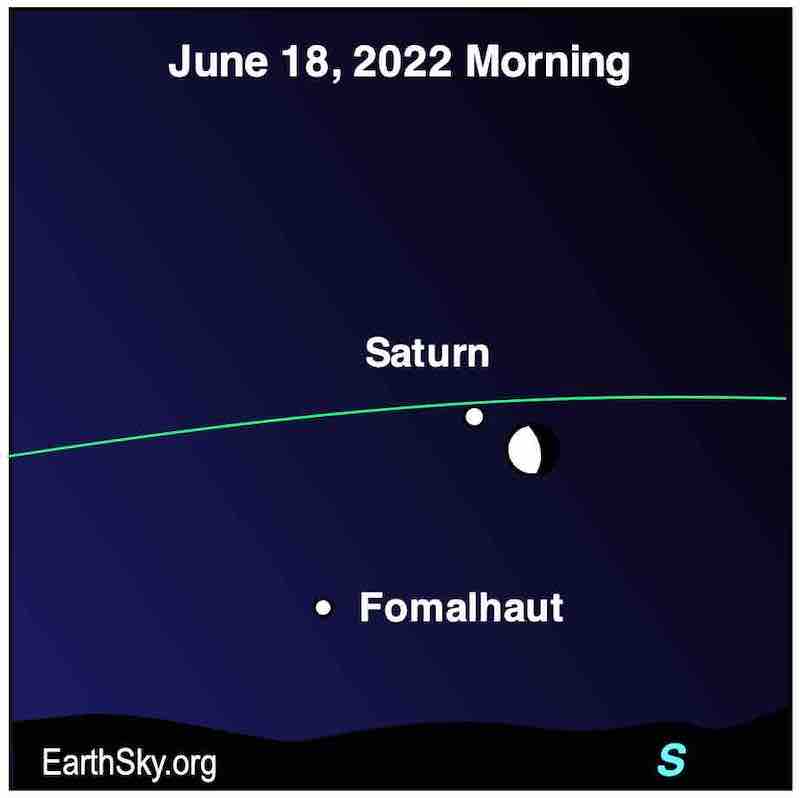
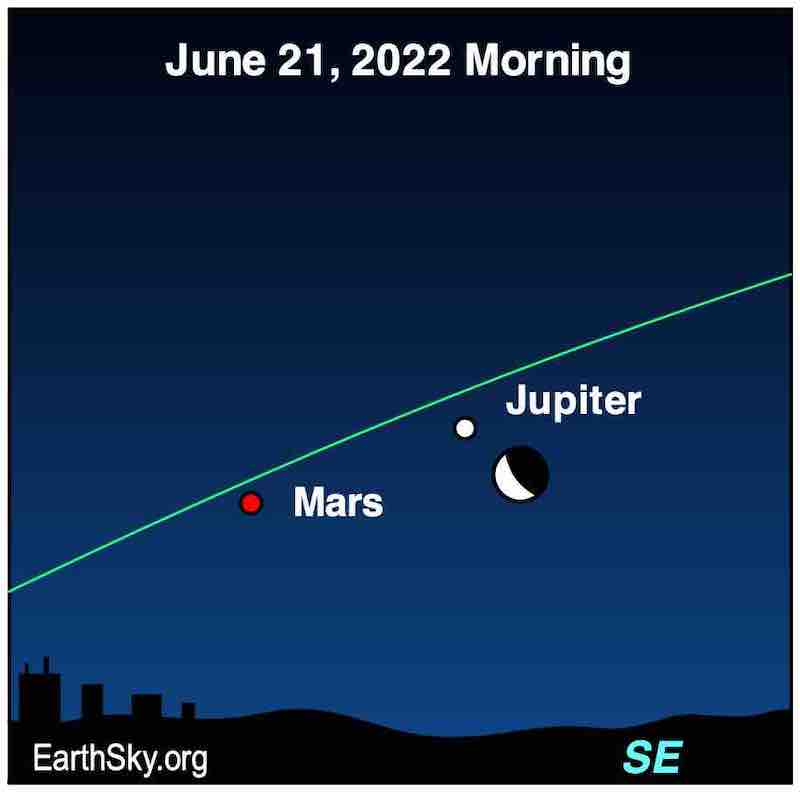
If you’re not familiar with which bright spot of light is which planet, the moon can be your tour guide. Follow it in June as it passes Saturn on the 18th, Jupiter on the 21st, Mars on the 22nd, Venus on the 26th and Mercury on the 27th. Notice also how the phase of the moon changes, narrowing as it moves toward new moon.
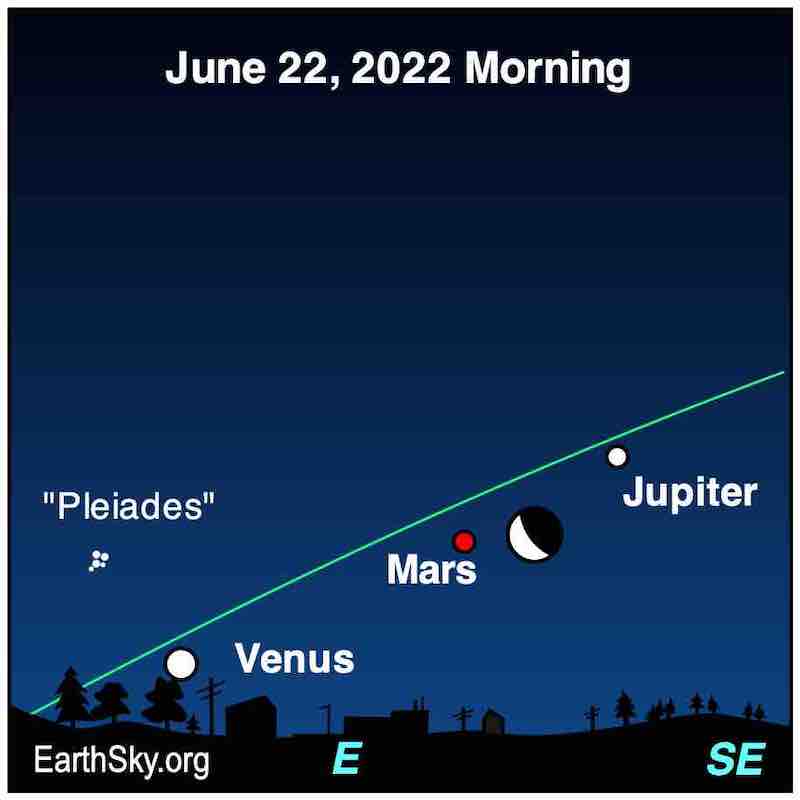
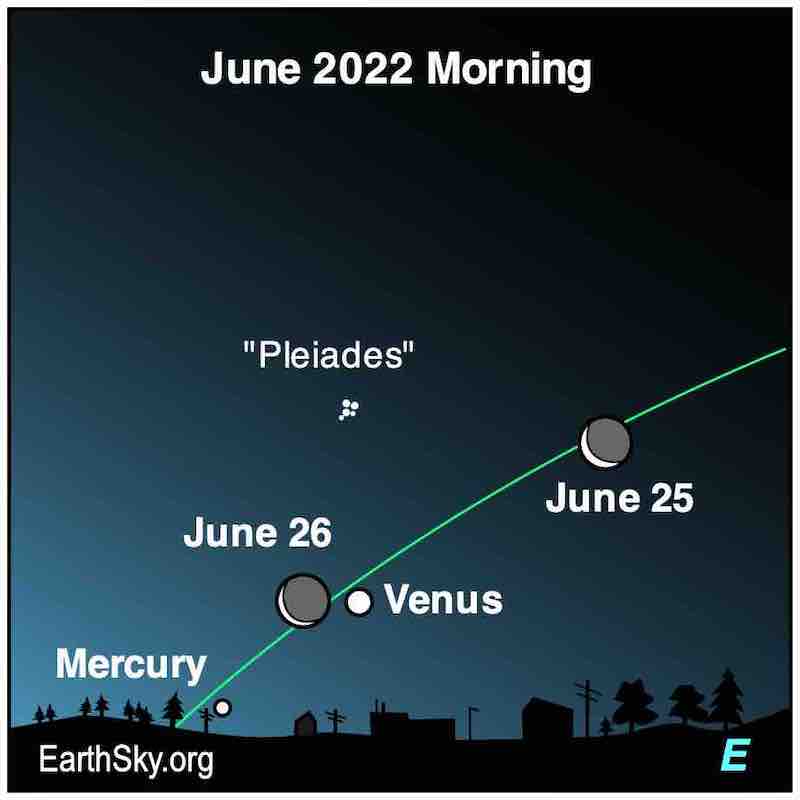
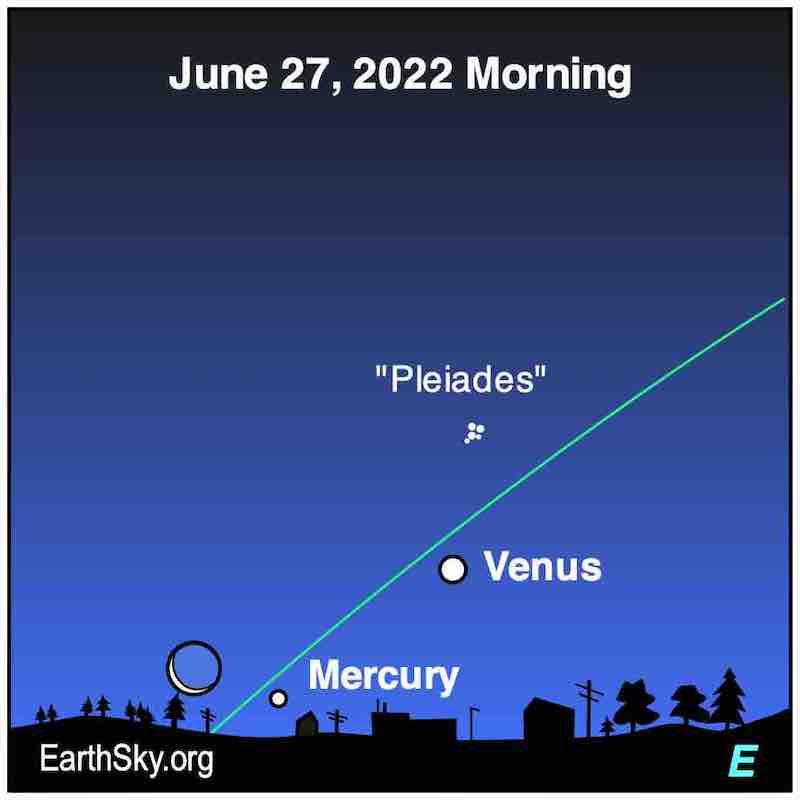
5 bright planets shifting apart
Notice how the planets shift from June 10, when Mercury first appears, to the end of the month. While they stay in order, the space between them expands. Mars and Jupiter were particularly close, coming off a conjunction at the end of May. They’ll continue to separate throughout June.
At the beginning of the event, the lineup of the five planets stretched 92 degrees across, taking up about half the sky. By June 30, the distance between first and last planets in the lineup, Mercury and Saturn, will have grown to 116 degrees. Most the planets will retain a similar brightness throughout June, but Mercury will slowly brighten each morning. Mercury grows brighter as it edges ever nearer to the sun, which is what will bring this lineup of 5 planets to an end. Eventually, Mercury will be too close to the sun to escape the dawn’s light.
Uranus and Neptune
If you want to spot Uranus and Neptune, you’re going to need a little help. A good star chart and a pair of binoculars should do the trick. Try Stellarium to find the locations of Uranus and Neptune on the nights you wish to observe.
Uranus, the brighter of the two, starts June closer to the horizon than Venus but ends the month higher in the sky than Venus. Your best bet to find Uranus is when it passes Venus around June 11. From the Northern Hemisphere, Uranus will be to the upper left of Venus, about three full-moon widths away. On June 12, Venus is about the same distance from Uranus but now almost directly below it.
Neptune doesn’t have anything as handy as a bright planet passing by to help you track it down. (That opportunity was on May 18 when Mars passed less than a half degree below Neptune.) Neptune is between Jupiter and Saturn, though much closer to Jupiter. It lies below the circlet of Pisces. You can find it on a star chart and then hop your way to it.
The path of the ecliptic
Now, if you know that the planets all trace the same path – called the ecliptic – because they’re all in the same plane of our solar system, you’ll know that the planets are all essentially “in a lineup” all the time. It’s just that most of the time the planets aren’t close enough together for you to easily distinguish that line. Oftentimes, some planets will be in the morning sky while others are in the evening sky, so not all planets are visible above the horizon at the same time.
Take advantage of this special opportunity in June to see them all lined up together across the morning sky.
Bottom line: You can spot a planetary lineup all through June. Look in the morning before sunrise for the five brightest planets stretching from the east-northeast toward the south.
The post Rare planetary lineup on June mornings first appeared on EarthSky.
from EarthSky https://ift.tt/e7caC8n
Aucun commentaire:
Enregistrer un commentaire